

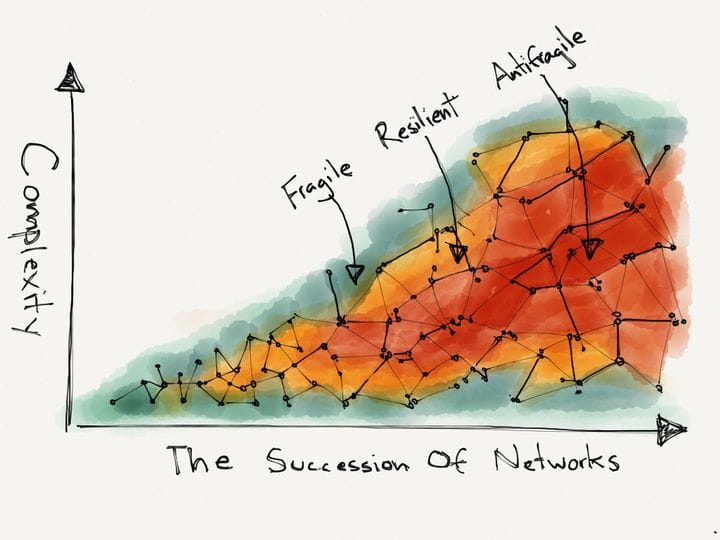
Building Antifragility: We often mistake strength for stability. But true resilience — or what Nassim Nicholas Taleb calls antifragility — isn’t about avoiding shocks. It’s about benefiting from them.
Antifragile systems grow stronger under pressure, while fragile ones collapse at the first sign of volatility. The difference lies not in intelligence or skill, but in exposure and structure.
Fragility and Freedom – Building Antifragility
If you’re a midlevel executive employee at some bank, if you punch out an annoying drunk in a bar you will likely get fired, get an arrest record, and be unhirable. You’re extremely fragile.
And then again at the lower end of the spectrum, say as a taxi driver, you have more freedom again because you are not so dependent on your reputation.
Taleb offers a simple heuristic:
People who don’t seem to care how they dress or look are robust or antifragile
People who have to wear suits and ties and worry about a bad reputation are fragile..
Learning in the Wild
Real language learning is done “in the wild,” suffering embarrassment for not knowing things and struggling to be understood….it’s not done through textbooks and texts.
The best horses lose when they compete with slower ones, and win against stronger rivals. Absence of challenge can degrade the best of us.
Even the best athletes and professionals lose their edge without challenge. Comfort, ironically, is the most dangerous form of fragility. For the unversed, the stoic technique of “practicing poverty” helps reduce your fragility from being afraid of losing your wealth.
Four Rules for Optionality
Optionality — the ability to keep doors open and benefit from uncertainty — is at the heart of Building Antifragility. Taleb suggests a few timeless rules:
- Look for optionality and rank things according to their optionality
- Look for things with open ended, not closed ended, payoffs
- Do not invest in business plans but in people, people who could change careers six or seven times
- Make sure you are barbelled, whatever that means in your business
As Taleb puts it, what is called “healthy” is generally unhealthy, just as “social” networks are antisocial, and the “knowledge”-based economy is typically ignorant.
Two Rules for Skin in the Game – Building Antifragility
Nothing exposes fragility faster than lack of skin in the game — making decisions that affect others but not yourself. Taleb’s two golden rules:
- Never get on a plane if the pilot is not on board and
- Always make sure there is also a copilot
Another rule: “Never ask anyone for their opinion, forecast, or recommendation. Just ask them what they have, or don’t have, in their portfolio.”
A Note on Human Nature
It’s ironic, but true: It is those who use others who are the most upset when someone uses them.
To stay grounded — stop reading daily news. Instead, to be completely cured of newspapers, spend a year reading the previous week’s newspapers. You’ll see how irrelevant most “urgent” stories are with time.
The characteristic feature of the loser is to bemoan, in general terms, mankind’s flaws, biases, contradictions, and irrationality–without exploiting them for fun and profit.
Skin in the Game: Accountability That Builds Real Strength
Having “skin in the game” means you share the risk and responsibility of your actions. You don’t just talk—you commit.
Why this matters for Building Antifragility
- It creates discipline.
- It eliminates ego-driven decision-making.
- It produces learning from real consequences—not theories.
Leaders who have skin in the game earn trust quickly because they:
- Lead by example
- Take ownership of failures
- Share rewards fairly
How to practice skin in the game Building Antifragility
a. Commit to your decisions
Stop overthinking—start doing. Action builds feedback loops.
b. Take calculated risks
Not reckless gambles, but meaningful steps that push growth.
c. Avoid blaming external factors
Antifragile people take responsibility and move forward.
Skin in the game ensures growth is authentic, not hypothetical.
Bringing It All Together: Building Antifragility
To Building Antifragility life or business:
- Use resilience to survive the unexpected.
- Use optionality to pivot and capture opportunities.
- Use skin in the game to grow with confidence and accountability.
When these three work together, you become someone who doesn’t fear uncertainty—you use it. You evolve through volatility. You grow through discomfort. You find opportunity in every challenge.
